
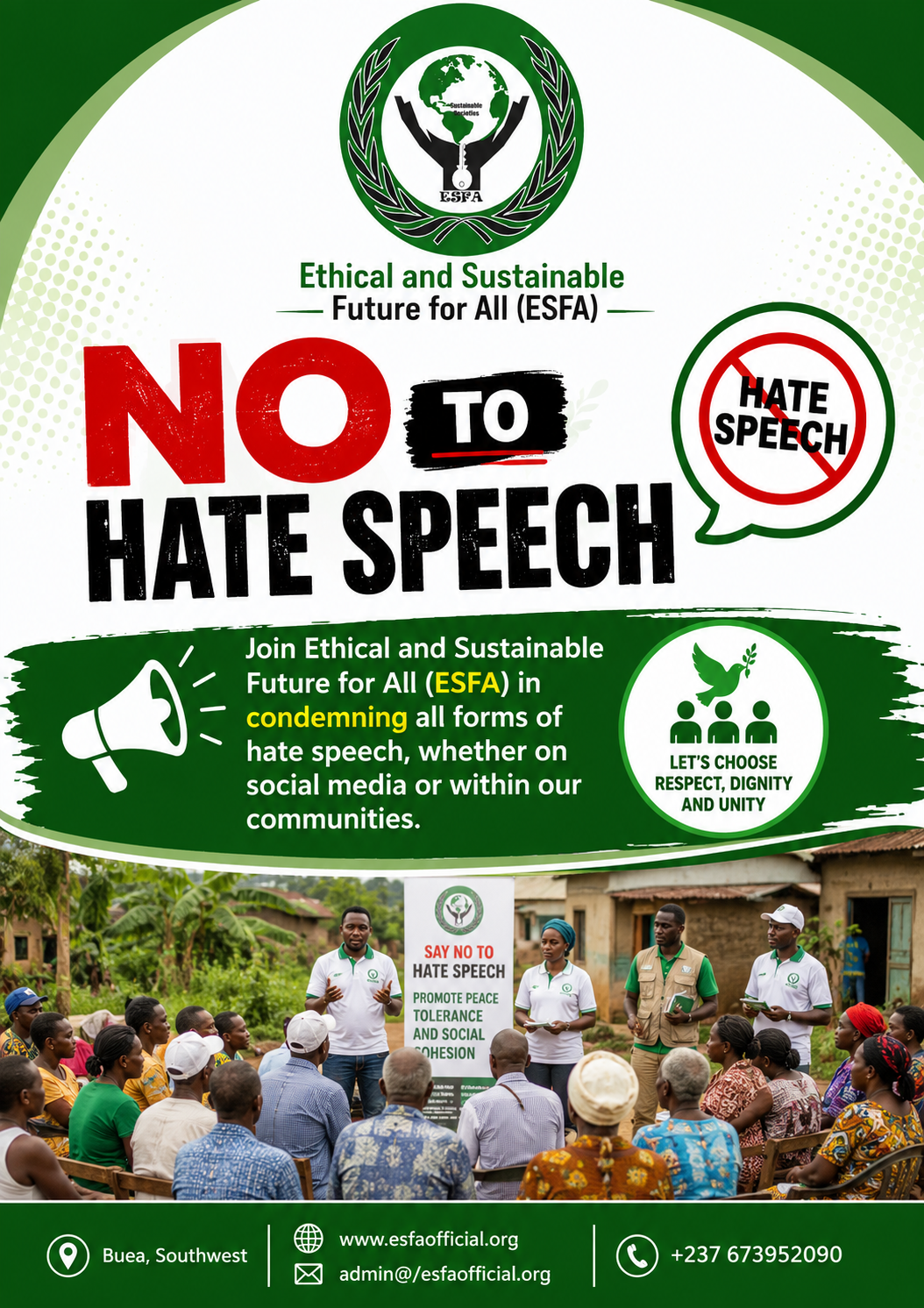
PRESS Release: Ethical and Sustainable Future for All (ESFA), Condemns the Rising Incidence of Hate Speech on Social Media Space in Cameroon
Buea, 17 July 2026: Ethical and Sustainable Future for All (ESFA) expresses its deep concern over the alarming rise in hate speech circulating across social media platforms in Cameroon, particularly on Facebook, TikTok, WhatsApp, X (formerly Twitter), and other digital communication platforms. The increasing use of inflammatory, discriminatory, and dehumanizing language against individuals and communities threatens national unity, peaceful coexistence, and the enjoyment of fundamental human rights.
In recent months, ESFA has observed a disturbing trend in which social media users increasingly target individuals and groups based on their ethnicity, tribe, religion, political affiliation, gender, or other aspects of their identity rather than engaging in constructive debate about their actions or ideas. Such expressions, whether in written, audio, or video form, contribute to polarization, deepen social divisions, and create an environment in which violence and discrimination can flourish.
We therefore call on all internet users to exercise restraint, demonstrate responsibility, and reject all forms of communication that promote hatred, intolerance, or hostility. Freedom of expression is a fundamental human right protected under national and international law; however, this freedom carries corresponding responsibilities and must never be used as a justification for inciting hatred, discrimination, or violence against others.
ESFA joins the international community in reaffirming that hate speech has no place in a democratic and peaceful society. The United Nations Strategy and Plan of Action on Hate Speech defines hate speech as:
“Any kind of communication in speech, writing or behaviour that attacks or uses pejorative or discriminatory language with reference to a person or a group on the basis of who they are, in other words, based on their religion, ethnicity, nationality, race, colour, descent, gender or other identity factor.”
This definition highlights that hate speech is not merely offensive language; it is communication that undermines the dignity, equality, and security of individuals and communities because of their identity. History has repeatedly shown that unchecked hate speech can contribute to discrimination, persecution, mass atrocities, and violent conflict.
International human rights and international criminal law recognize the serious dangers posed by hate speech. Article 20(2) of the International Covenant on Civil and Political Rights (ICCPR) requires States to prohibit by law any advocacy of national, racial, or religious hatred that constitutes incitement to discrimination, hostility, or violence. Similarly, Article 4 of the International Convention on the Elimination of All Forms of Racial Discrimination (ICERD) obliges States to criminalize the dissemination of ideas based on racial superiority or hatred and to prohibit organizations that promote such discrimination.
Furthermore, the Rome Statute of the International Criminal Court (1998) recognizes that direct and public incitement to commit genocide constitutes an international crime. While not every instance of hate speech amounts to an international crime, hate speech that intentionally and publicly incites genocide or other atrocity crimes may attract individual criminal responsibility under international law. This underscores the importance of preventing dangerous forms of hate speech before they escalate into violence or mass atrocities.
At the national level, Cameroon has taken legislative measures to address hate speech. Law No. 2019/020 of 24 December 2019, which amended and supplemented certain provisions of the Penal Code, introduced Section 241-1 relating to Contempt of Tribe or Ethnic Group. The law criminalizes hate speech directed against persons because of their tribal or ethnic origin and provides penalties of imprisonment ranging from one to two years, together with fines ranging from 300,000 FCFA to 3,000,000 FCFA. The law further provides enhanced penalties where the perpetrator is a public servant, political party leader, media practitioner, leader of a non-governmental organization, or religious leader, reflecting the greater influence and responsibility associated with such positions.
ESFA strongly condemns all forms of hate speech, whether committed online or offline. We call upon law enforcement authorities and relevant regulatory institutions to impartially investigate cases of hate speech that amount to criminal offences under Cameroonian law and to ensure that perpetrators are held accountable through due process and in accordance with the rule of law.
At the same time, legal enforcement alone cannot eliminate hate speech. Sustainable solutions require collective action from all sectors of society. We therefore encourage civil society organizations, media institutions, educational establishments, religious leaders, traditional authorities, community leaders, digital influencers, and technology companies to intensify public education and awareness campaigns on responsible digital citizenship, ethical communication, tolerance, and peaceful coexistence.
Social media platforms have become powerful spaces for civic engagement, democratic participation, and public discourse. These platforms must not be transformed into arenas for tribalism, discrimination, intimidation, misinformation, or incitement. Every Cameroonian has a responsibility to use digital platforms in ways that promote dialogue, mutual respect, and social cohesion.
ESFA also encourages citizens to verify information before sharing it, refrain from amplifying inflammatory content, report hate speech through appropriate platform reporting mechanisms and competent authorities where necessary, and engage respectfully with differing opinions. Promoting respectful dialogue and responsible online behaviour is essential to protecting civic space and strengthening democracy.
As an organization committed to the promotion of human rights, peacebuilding, sustainable development, and social justice, Ethical and Sustainable Future for All (ESFA) reiterates its unwavering commitment to combating hate speech and promoting a culture of tolerance, inclusion, respect for diversity, and human dignity.
We urge every citizen to stand against hatred by choosing words that heal rather than divide, that build rather than destroy, and that unite rather than polarize. Together, let us build our communities, founded on peace, mutual respect, social cohesion, and the rule of law.
#NoToHateSpeech
#PromotePeace
#ProtectHumanDignity
#ResponsibleDigitalCitizenship
Berinyuy Cajetan, President,
Ethical and Sustainable Future for All (ESFA).
Buea, Southwest
www.esfaofficial.org
admin@esfaofficial.org
+237 673952090

