
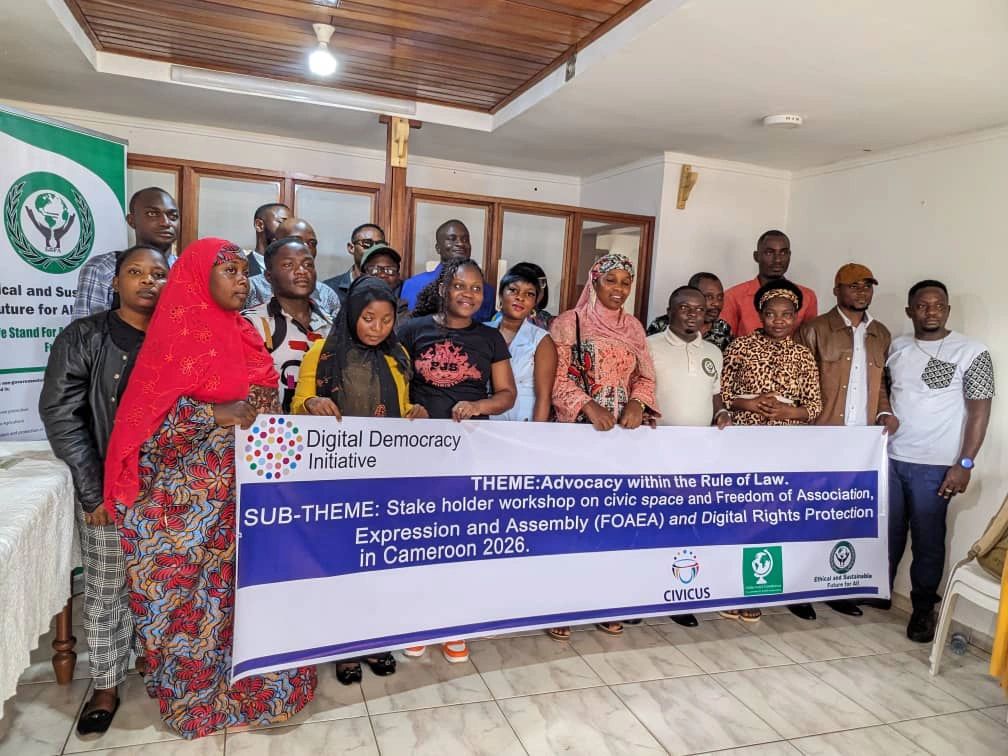
Stakeholder Workshop on Freedom of Association, Expression and Assembly (FOAEA) and Digital Rights Protection in Cameroon
Date: 1 August 2026
Venue: Yaoundé, Centre Region, Cameroon
Organizers: Ethical and Sustainable Future for All (ESFA) in partnership with Globe Watch Foundation (GWF)
Project: Advocacy within the Rule of Law: Stakeholder Workshop on FOAEA and Digital Rights Protection in Cameroon
Funder: Digital Democracy Initiative (DDI)
Coordinator: CIVICUS

On 1 August 2026, Ethical and Sustainable Future for All (ESFA), in partnership with Globe Watch Foundation (GWF), organized a high-level working session and capacity-building workshop in Yaoundé, Centre Region of Cameroon, under the theme “Advocacy within the Rule of Law: Stakeholder Workshop on Freedom of Association, Expression and Assembly (FOAEA) and Digital Rights Protection in Cameroon.”
The workshop formed part of an ongoing project implemented jointly by ESFA and GWF, funded by the Digital Democracy Initiative (DDI) and coordinated by CIVICUS. The initiative seeks to strengthen the capacity of civil society actors, human rights defenders, youth leaders, media professionals and other stakeholders to effectively promote civic freedoms, protect digital rights, and engage in evidence-based advocacy within the framework of the rule of law.
The activity was organized against the backdrop of evolving challenges affecting civic space in Cameroon, including restrictions and emerging concerns surrounding freedom of expression, association and peaceful assembly, as well as the increasing risks associated with digital communication. The rapid expansion of digital platforms has created new opportunities for civic participation while simultaneously generating challenges related to hate speech, misinformation, disinformation, defamation, online incitement, privacy and responsible digital citizenship.
The workshop therefore provided an important platform for stakeholders to share experiences, examine existing challenges, enhance their knowledge and identify practical approaches for protecting civic space and promoting responsible participation both offline and online.
Objectives of the Workshop
The workshop sought to achieve the following objectives:
- To strengthen participants’ understanding of Freedom of Association, Expression and Assembly (FOAEA) within national and international human rights frameworks.
- To enhance the capacity of civil society actors and other stakeholders to undertake effective, strategic and evidence-based advocacy.
- To examine emerging threats to civic space and identify practical approaches for addressing them.
- To increase participants’ understanding of digital rights, online safety and the legal boundaries governing digital expression.
- To promote responsible digital citizenship and ethical use of digital platforms.
- To facilitate dialogue and collaboration among civil society, media, youth and other relevant stakeholders.
- To identify innovative approaches for coordinated civil society engagement and the protection of civic freedoms in Cameroon.
Participation and Methodology
The workshop brought together civil society actors, human rights defenders, youth leaders, media professionals and other key stakeholders with an interest in civic space, human rights, digital rights and democratic participation.
The methodology was highly participatory and practical. Rather than relying exclusively on conventional presentations, the workshop encouraged participants to share their experiences, raise concerns, examine practical scenarios and contribute to discussions on the challenges affecting civic participation in Cameroon.
Expert presentations provided participants with relevant conceptual and legal information, while interactive discussions enabled them to relate the issues discussed to their respective professional and community contexts. This approach facilitated peer learning and encouraged participants to identify practical solutions to common challenges.
The participatory nature of the workshop also created opportunities for networking, experience-sharing and strengthening collaboration among stakeholders working to promote human rights, civic freedoms and digital security.

Key Issues Discussed
Freedom of Association, Expression and Assembly
Participants examined the importance of FOAEA as fundamental components of a democratic society. Discussions focused on the need to ensure that citizens, civil society organizations, media professionals and other groups can organize, express their views and participate peacefully in public affairs while respecting applicable laws.
The discussions emphasized the importance of exercising these freedoms within the framework of the rule of law and international human rights standards. Participants also highlighted the need for constructive engagement between civil society and public institutions to promote accountability, transparency and respect for fundamental freedoms.
Digital Rights and Responsible Online Participation
A significant component of the workshop focused on digital rights and the rapidly changing online environment. Participants examined issues including hate speech, defamation, misinformation, disinformation and online incitement, as well as the responsibilities that accompany digital expression.
The discussions highlighted the need for citizens and civil society actors to understand the legal and ethical implications of online communication. Participants were encouraged to verify information before sharing it, avoid content that may promote violence or discrimination, and use digital platforms responsibly to advance constructive civic dialogue.
Strategic Advocacy and Civic Engagement
Participants explored practical approaches to strategic advocacy, including the importance of evidence-based messaging, stakeholder engagement, coordinated action and constructive policy dialogue.
The session underscored the need for civil society organizations to strengthen their capacity to document issues affecting communities, develop credible advocacy messages and engage relevant decision-makers. Participants further recognized that coordinated advocacy can increase the effectiveness and visibility of efforts aimed at influencing public policy and institutional reforms.
Key Outcomes
The workshop resulted in several important outcomes:
- Improved understanding of FOAEA: Participants enhanced their understanding of the importance and legal dimensions of freedom of association, expression and peaceful assembly.
- Increased awareness of digital rights: Participants gained greater awareness of digital rights, online risks and the legal and ethical boundaries surrounding digital expression.
- Strengthened advocacy knowledge: Participants acquired practical insights into strategic, evidence-based and rights-based advocacy approaches.
- Enhanced peer learning: The participatory methodology enabled stakeholders to exchange experiences, challenges and practical solutions.
- Promotion of responsible digital citizenship: Participants recognized the importance of ethical online engagement, information verification and responsible use of digital platforms.
- Strengthened networking and collaboration: The workshop created opportunities for participants from different sectors to establish and strengthen relationships for future collaboration.
- Commitment to civic space protection: Participants reaffirmed their commitment to promoting an open, inclusive and resilient civic environment in Cameroon.
Lessons Learned
The workshop demonstrated that practical and participatory learning approaches are effective in addressing complex civic space and digital rights issues. Participants were able to connect legal and theoretical concepts with real-life experiences, thereby making the discussions more relevant and applicable.
The discussions also demonstrated that protecting civic space requires collaboration among multiple stakeholders. Civil society organizations, human rights defenders, youth, media professionals, public institutions and other actors have complementary roles in promoting democratic participation and protecting fundamental freedoms.
Furthermore, the increasing importance of digital platforms in civic engagement makes digital literacy, online safety and responsible digital citizenship essential components of contemporary human rights and advocacy work.
Recommendations and Way Forward
Based on the discussions, the following recommendations emerged:
- Continue building the capacity of civil society actors and human rights defenders on FOAEA, digital rights and strategic advocacy.
- Promote greater awareness of national and international legal standards protecting civic freedoms.
- Strengthen responsible digital citizenship and digital literacy among young people and other online users.
- Encourage civil society organizations to adopt evidence-based approaches to advocacy and policy engagement.
- Promote stronger coordination and information-sharing among civil society actors working on civic space and digital rights.
- Strengthen constructive engagement between civil society and relevant public institutions.
- Develop sustained multi-stakeholder initiatives to address emerging threats to civic space and digital freedoms.
- Encourage ethical leadership, professionalism and respect for human rights in both physical and digital civic spaces.
Conclusion
The Stakeholder Workshop on Freedom of Association, Expression and Assembly (FOAEA) and Digital Rights Protection in Cameroon provided an important platform for dialogue, capacity building, experience-sharing and networking among civil society actors, human rights defenders, youth leaders, media professionals and other stakeholders.
The practical and participatory nature of the workshop enabled participants to critically examine challenges affecting civic space while identifying concrete approaches for strategic advocacy, responsible digital engagement and multi-stakeholder collaboration.
The activity reaffirmed the importance of protecting civic freedoms and digital rights as essential elements of democratic governance and sustainable development. ESFA and GWF, with the support of the Digital Democracy Initiative and coordination of CIVICUS, remain committed to strengthening the capacity of civil society and other stakeholders to promote an open, inclusive, rights-based and digitally secure civic environment in Cameroon.

