
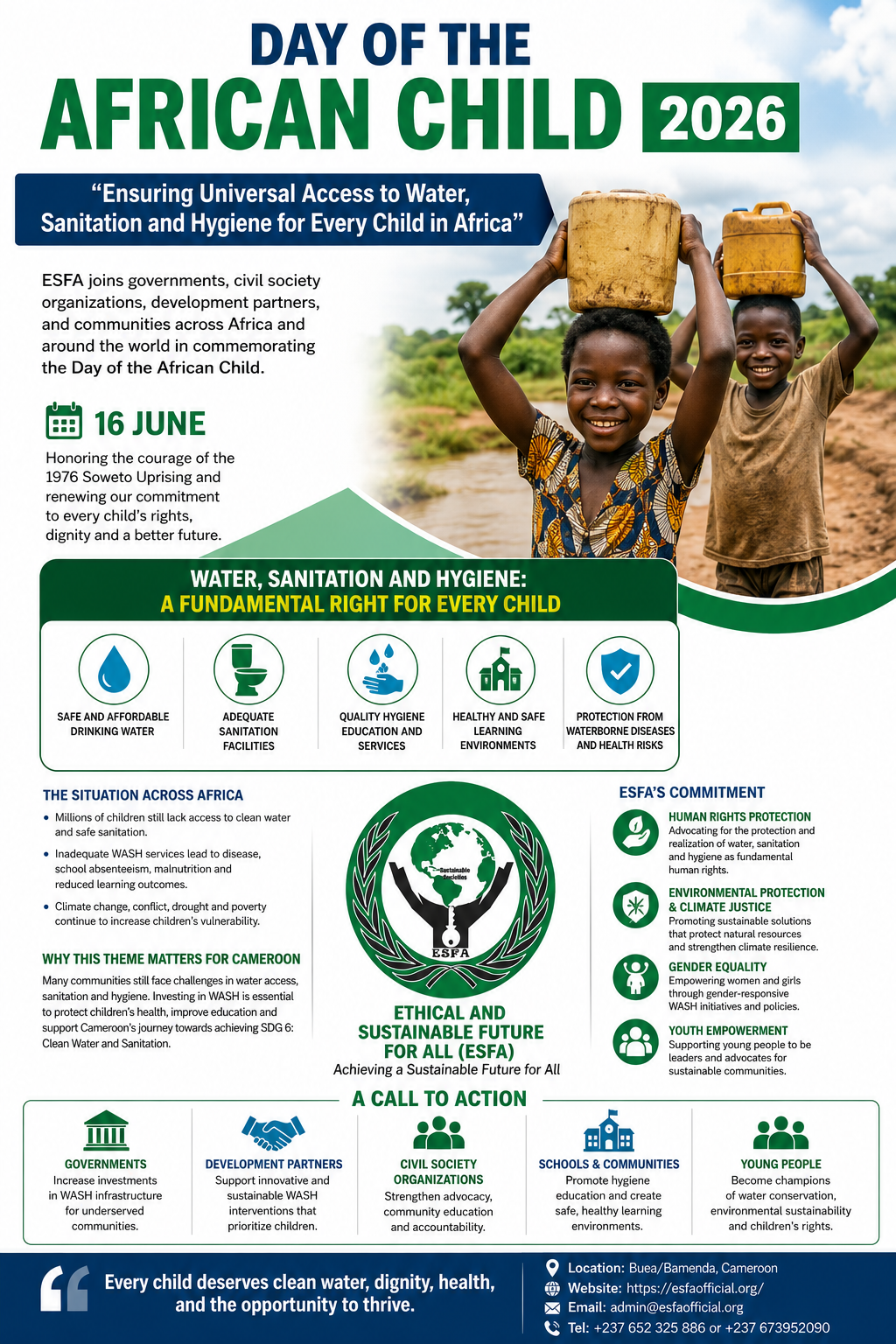
Join ESFA in Commemoration of the Day of the African Child 2026: Ensuring Universal Access to Water, Sanitation and Hygiene for Every Child in Africa
ESFA Joins the Global Community in Commemorating the Day of the African Child 2026
Ethical and Sustainable Future for All (ESFA) joins governments, civil society organizations, development partners, and communities across Africa and around the world in commemorating the Day of the African Child (DAC) 2026.
Every year on 16 June, Africa observes the Day of the African Child to honor the courage and sacrifice of thousands of schoolchildren who participated in the 1976 Soweto Uprising in South Africa. These young students took to the streets to protest against the poor quality of education and discriminatory policies imposed by the apartheid regime. Their bravery became a powerful symbol of the struggle for children’s rights, dignity, equality, and access to quality education across the continent.
Established in 1991 by the Organization of African Unity (OAU), now the African Union (AU), the Day of the African Child provides an opportunity for governments, civil society organizations, communities, and development partners to reflect on the state of children’s rights and renew their commitment to building a brighter future for every African child.
This year, the African Union commemorates the Day of the African Child under the theme:
“Ensuring Universal Access to Water, Sanitation and Hygiene for Every Child in Africa.”
This theme draws attention to one of the most urgent yet preventable challenges facing millions of children across the continent: the lack of access to clean water, safe sanitation facilities, and adequate hygiene services.
Water, Sanitation and Hygiene: A Fundamental Right for Every Child
Access to safe drinking water and adequate sanitation is not a privilege—it is a fundamental human right recognized under international human rights law. Yet millions of children across Africa continue to face significant barriers in accessing these essential services.
For many children, particularly those living in rural and underserved communities, obtaining clean water often requires walking long distances every day. This burden frequently falls on girls, limiting their educational opportunities and exposing them to various risks. Inadequate sanitation facilities in schools and communities contribute to the spread of preventable diseases such as cholera, typhoid, diarrheal diseases, and intestinal infections, which disproportionately affect children.
Poor hygiene practices and limited access to handwashing facilities further increase children’s vulnerability to disease outbreaks. These challenges undermine children’s health, educational attainment, dignity, and overall well-being.
The 2026 theme therefore calls for urgent and collective action to ensure that every child, regardless of their location or circumstances, has access to:
- Safe and affordable drinking water;
- Adequate sanitation facilities;
- Quality hygiene education and services;
- Healthy and safe learning environments; and
- Protection from waterborne diseases and environmental health risks.
The Situation Across Africa
Although significant progress has been made in expanding water and sanitation services across Africa, considerable challenges remain.
Many schools still operate without reliable water sources, functional toilets, or adequate handwashing facilities. During periods of drought, flooding, conflict, or displacement, children’s access to safe water becomes even more precarious. Climate change has further intensified water scarcity in many regions, disproportionately affecting vulnerable communities.
The consequences are severe and far-reaching:
- Increased child mortality due to preventable diseases;
- Higher rates of school absenteeism, particularly among girls;
- Malnutrition and stunted growth;
- Reduced educational performance; and
- Increased vulnerability during humanitarian emergencies.
Addressing these challenges requires sustained investments in water and sanitation infrastructure, effective governance, community participation, and inclusive policies that place children at the center of development efforts.
Why This Theme Matters for Cameroon
In Cameroon, many communities continue to face challenges related to access to clean water, adequate sanitation facilities, and proper hygiene services. Rural communities, informal settlements, and conflict-affected areas remain particularly vulnerable.
Children often bear the greatest burden. Limited access to safe water contributes to health complications that negatively affect school attendance and learning outcomes. Inadequate sanitation facilities in schools can also discourage attendance, particularly among adolescent girls.
As Cameroon continues its efforts to achieve the Sustainable Development Goals (SDGs), especially SDG 6: Clean Water and Sanitation, there is an urgent need to strengthen investments in child-centered Water, Sanitation and Hygiene (WASH) initiatives.
The Day of the African Child 2026 presents an important opportunity for policymakers, civil society organizations, community leaders, development partners, and citizens to recommit themselves to ensuring that no child is left behind.
ESFA’s Commitment to Children’s Rights and Sustainable Development
At Ethical and Sustainable Future for All (ESFA), we believe that every child deserves the opportunity to grow, learn, and thrive in a safe, healthy, and supportive environment.
Founded in 2019 and officially registered in 2021, ESFA works to promote and protect human rights, sustainable development, gender equality, climate justice, peace, and community resilience. Through our Human Rights, Gender, Environmental Protection, Humanitarian, and Peace and Conflict Prevention Departments, we contribute to building inclusive and sustainable communities where children and young people can reach their full potential.
The 2026 Day of the African Child theme closely aligns with ESFA’s vision of achieving a sustainable future for all. Access to clean water, sanitation, and hygiene is directly connected to several key areas of our work.
Human Rights Protection
Safe water and sanitation are fundamental human rights. ESFA advocates for the protection, promotion, and realization of these rights, particularly for vulnerable and marginalized populations.
Environmental Protection and Climate Justice
Climate change continues to threaten water security across Africa. Through environmental awareness initiatives and climate justice advocacy, ESFA promotes sustainable solutions that protect natural resources for present and future generations.
Gender Equality
Women and girls are disproportionately affected by inadequate water and sanitation services. ESFA remains committed to empowering women and girls and promoting gender-responsive approaches to sustainable development.
Youth Empowerment
Young people are powerful agents of change within their communities. ESFA supports youth participation in advocacy, leadership, environmental stewardship, and sustainable development initiatives that contribute to positive social transformation.
A Call to Action
As we commemorate the Day of the African Child 2026, ESFA calls upon:
Governments
To increase investments in water, sanitation, and hygiene infrastructure, particularly in underserved, rural, and vulnerable communities.
Development Partners
To support innovative, sustainable, and child-centered WASH interventions that prioritize children’s health, education, and well-being.
Civil Society Organizations
To strengthen advocacy efforts, community education, and accountability mechanisms that promote equitable access to quality water and sanitation services.
Schools and Communities
To promote hygiene education and create safe, healthy, and inclusive learning environments where children can thrive.
Young People
To become champions of environmental sustainability, water conservation, and children’s rights within their communities.
Building a Sustainable Future for Every Child
The Day of the African Child reminds us that children are not only the leaders of tomorrow—they are rights holders today. Ensuring universal access to water, sanitation, and hygiene is essential for protecting children’s health, improving educational outcomes, advancing gender equality, and achieving sustainable development across Africa.
As we honor the legacy of the children of Soweto, let us transform remembrance into meaningful action. Together, we can build an Africa where every child enjoys the right to clean water, safe sanitation, quality education, good health, and a dignified future.
Ethical and Sustainable Future for All (ESFA) remains committed to working alongside communities, partners, institutions, and stakeholders to advance human rights, environmental sustainability, gender equality, child protection, and social justice in pursuit of a sustainable future for all.
Happy Day of the African Child 2026!
“Every child deserves clean water, dignity, health, and the opportunity to thrive.”

